

At 88, former Somaliland foreign minister Edna Adan Ismail bubbles with enthusiasm about Israel’s landmark recognition of the state in December.
“I’m so glad that we can openly say the word, Israel, because there was a time when we would not be sure about how people would respond to that,” she told The Times of Israel on a recent video call.
Last month, Somaliland President Abdirahman Mohamed Abdullahi said he had accepted an invitation from Prime Minister Benjamin Netanyahu to visit Israel and sign a trade agreement in the near future, but no date has been set. Foreign Minister Gideon Sa’ar visited the deeply traditional Muslim country in early January.
The country’s first trained female nurse-midwife, who served as Somaliland’s top diplomat between 2003 and 2006, Edna has earned the moniker “first lady” of Somaliland because of her lifelong dedication to the country.
She prefers that people refer to her as “simply Edna” because, she explained, in Somaliland people have their given name, then their father’s name, followed by their grandfather’s name.
“We’re not fundamentalists,” she said. “Yes, we’re Muslim. We respect our religion, but then we also respect other people’s religions as well.”
Edna said she was already working on the Israeli-Somaliland relationship when she was foreign minister over two decades ago.
“This is just a natural collaboration with good people who are doing good work with us and who have been good to us,” Edna said. “And then I think the most important reason, of course, is strategic, because we depend on each other for our mutual survival.”
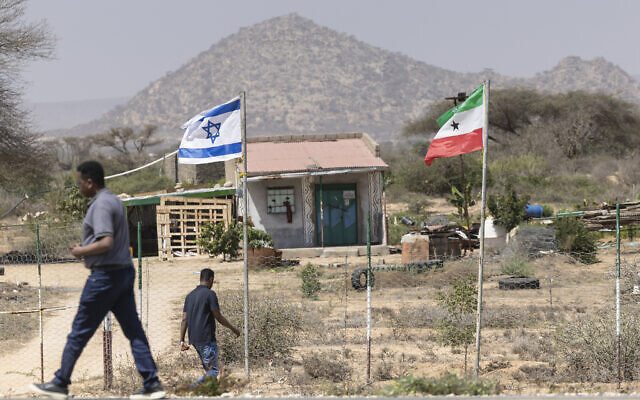
People walk by the flags of Israel and Somaliland at the entrance to a fruit farm between the capital city of Hargeisa and the port city of Berbera along the highway connecting the two as Muslims commemorate the holy month of Ramadan in Somaliland on February 19, 2026. (Tony KARUMBA / AFP)
Israel’s decision to recognize Somaliland has drawn an angry response from Somalia and has been criticized by China, Turkey, Egypt, and the African Union.
Somaliland also cooperates with the UAE and Taiwan, though only Israel has formally recognized the country.
The government in Mogadishu still considers Somaliland an integral part of Somalia even though the territory has run its own affairs since 1991, with its own passport, currency, army and police forces.
During his visit, Sa’ar said, “The recognition and establishment of diplomatic relations between the two countries are not directed against anyone.”
The history of Somaliland and Somalia
On the horn of Africa and the coast of the Red Sea, Somaliland is often described as a breakaway region of Somalia, but that notion is wrong, Edna said.
Once a protectorate of Britain, Somaliland gained its independence on June 26, 1960, five days before Somalia, a former territory of Italy, gained its own.
Israel was among the 35 nations to recognize Somaliland’s sovereignty at the time.
Somaliland united with Somalia for a period of time, but the union was fraught.
Between 1960 and 1991, Somalia’s president and military dictator, Siad Barre, killed more than 200,000 people, mostly of the Isaaq clan — of which Edna is a member — in Somaliland.
According to a 1989 US State Department report, Barre flattened Somaliland’s largest cities, unleashing deliberate famine, rape, and water poisoning, and “killing people because of their ethnic identity.”
“Somalia conducted mass executions, with mass graves dug out with hundreds of bodies,” Edna said. “Israel was the only country that voiced its condemnation of the genocide.”
In 1991, Somaliland declared its autonomy from Somalia, though international recognition did not follow.
Today, Somaliland has just over 6 million people and a per capita GDP of $1,500, one of the lowest in the world. Although it still lacks international recognition, it has maintained a surprisingly stable democracy even as “we’re still surrounded by hostile Somalia,” Edna said.
“If any other country, and not Israel, had recognized Somaliland, Somalia would have had the same reaction, the same backlash,” she said. “The fact that we are alive and breathing, and we did not all get exterminated, is too much for them.”
Building a hospital on a ‘killing ground’
In the 1980s, after training to become a nurse-midwife in England, Edna worked for the World Health Organization in various positions, including as a technical officer in Mother and Child Health and Family Planning in the Eastern Mediterranean region.
In 1991, she returned to Hargeisa, Somaliland’s capital, and found “a ghost town.” Much of the city had been leveled in years of fighting for Somaliland’s independence.
She sold most of her possessions and cashed in her pension to buy land that was once a “killing ground,” setting to work on building a hospital, which she said was the only way she could “heal my people.”
The Edna Adan Hospital, which opened in 2002, has delivered more than 30,000 babies over the years. She then established the Edna Adan University to train future nurses, doctors, and medical staff.
“I would like my hospital to continue training our people,” she said. “If it can be done on a former killing ground, it can be done anywhere.”
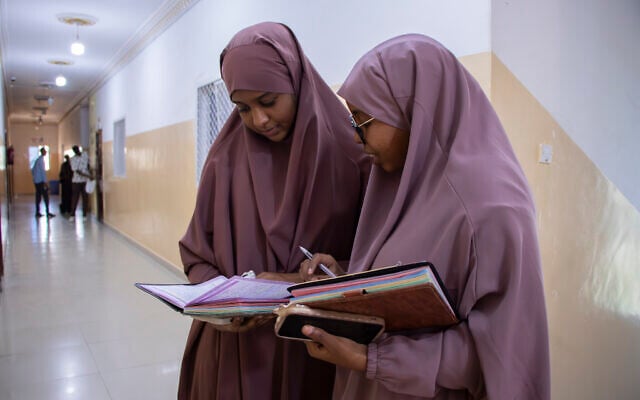
Girls studying at Edna Adan University in Hargeisa, Somaliland. (Courtesy)
Dr. Adam Lee Goldstein, director of trauma surgery at the Wolfson Medical Center in the Tel Aviv suburb of Holon and co-director of Operating Together, an Israeli-Palestinian healthcare initiative, first met Edna when he volunteered at the hospital in 2003 and has returned to Somaliland several times to train doctors there.
“She’s just a special woman and a force to be reckoned with,” Goldstein told The Times of Israel after his most recent visit to the hospital in early February. “The country is a very conservative religious place. I mean, women aren’t allowed to show any hair, and every other building is a mosque. But I didn’t see any radical or extreme kind of presence or energy that I have felt in other parts of the world. And they really want peace.”
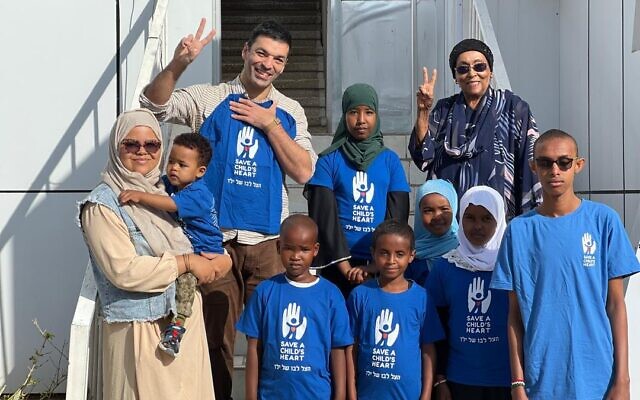
Dr. Adam Lee Goldstein, director of Trauma Surgery at Wolfson Medical Center and co-director of Operating Together, left, back row, during a recent visit where he gave courses in trauma at the Edna Adan Hospital in Hargeisa, Somaliland, with Edna Adan, right, back row, founder and president of the hospital, and children who had heart surgeries through Save a Child’s Heart (SACH), an Israeli humanitarian organization. Holding a child in the front row is Dr. Amal Farah, head of surgery at the hospital. (Courtesy/Save a Child’s Heart)
On his most recent trip, Goldstein gave courses in trauma surgery and also met children who had undergone heart surgeries at Wolfson through Save a Child’s Heart (SACH), an Israeli humanitarian organization founded in 1995 that has treated almost 8,000 children from 75 countries where access to pediatric cardiac care is limited or nonexistent.
According to a SACH spokesperson, the relationship between Israel and Somaliland began in 2004, when a Somaliland diplomat based in Ethiopia approached the Israeli Embassy to help save his son’s life.
With the embassy’s support, SACH flew the boy to Israel, where he had surgery. His life was saved, but the diplomat’s job was lost: all connections with Israel were roundly condemned.
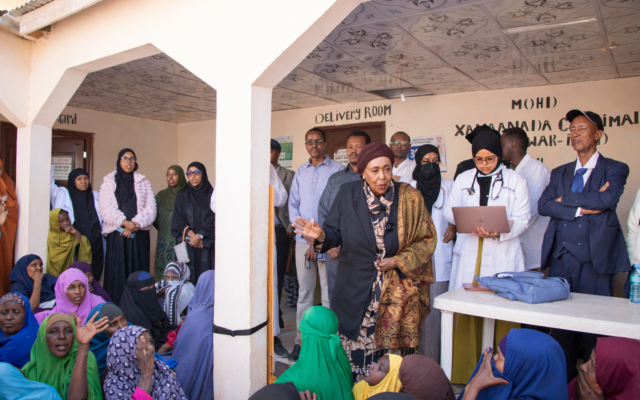
Edna Adan, center, and Dr. Amal Farah, right, visit a clinic in rural Somaliland. (Courtesy)
In 2012, two children traveled from Hargeisa to Tel Aviv for heart surgery through SACH. However, it wasn’t until 2021, when Goldstein volunteered at the hospital, that the relationship between SACH and Somaliland was formally established.
Since then, SACH has treated 41 children from Somaliland in Israel.
The fight against female genital mutilation
Over the years, Edna has received a variety of international awards for her work as an activist against female genital mutilation, or FGM.
In her autobiography, “A Woman of Firsts,” she writes that in 1945, when she was eight years old, her father, a doctor, went away to treat some patients. In his absence, her mother and grandmother arranged for an elderly woman to perform infibulation, the most severe form of female genital mutilation on Edna, without anesthetics, stitching her up with acacia thorns.
It took Edna 31 years to publicly speak out against the practice in 1976.
According to WHO, more than 230 million girls and women around the world have been subjected to FGM procedures for non-medical purposes, which include pricking, piercing, incising, scraping, and cauterization of the female genitalia.
“I’ve been fighting this for many years,” Edna said. “But there is so much opposition, so much rejection, so much resistance against ending the practice.”
“Sometimes when you’re fighting a very strong enemy, you have to go back to the drawing board and re-strategize what is going to work.”
She said there are three types of FGM, with infibulation, or Type 3, being the most severe. Types 1 and 2 include partial or total removal of part of the female genitalia.
She said that “zero tolerance, total eradication” was “not realistic.”
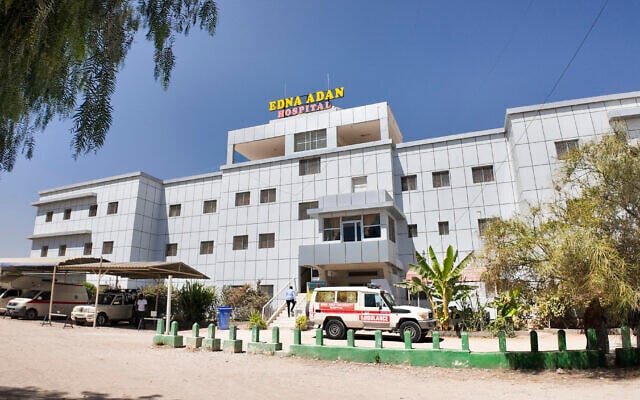
The Edna Adan Hospital in Hargeisa, Somaliland, founded and built by Edna Adan. (Courtesy)
At the hospital, she said that 70% of the women who arrive to deliver babies between the ages of 25 and 35 have had some form of FGM.
Most of them have had Type 1 FGM, which is called Mild Sunna in Somaliland and other Muslim countries.
“This means that the more severe Type 3, which is also known as infibulation, is on the decline,” she said.
“This does not mean that we are in favor of the continuation of all forms of FGM,” Edna said. “But we feel that if we do away with the more severe form, future generations who are better educated will fight Type 1 and Type 2.”
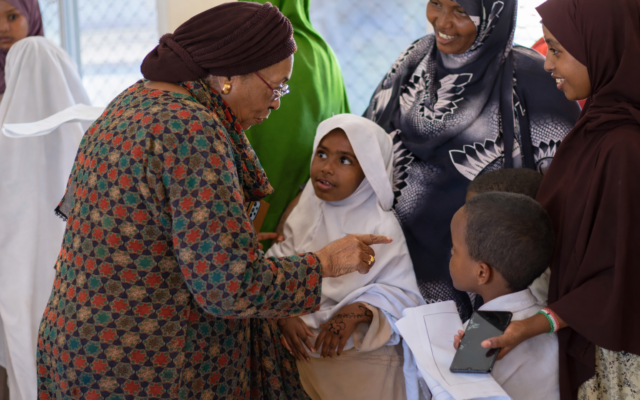
Edna Adan meets with children in Somaliland in an undated photo. (Courtesy)
She also pointed out that Somaliland was the first country to pronounce a fatwa, a religious Islamic law, banning infibulation four years ago.
“Islam forbids mutilation and cutting, so we started including fathers and religious imams to join the battle because before it was really only crazy women like me who were fighting it,” she said. “By having imams join the battle, it gave strength.”
When asked what keeps her going, Edna replied that she’s “hardheaded.”
“I’m proud of what Somaliland has achieved in three decades, and I would like the rest of the world to appreciate it,” she said. “Israel and Somaliland are people who have the same characteristics of determination.”
